Care is charted minute by minute. The break record goes quiet.
MicroForensics, built for small and mid-sized assisted living, post-acute, and home health operators running around-the-clock care with W-2 caregivers and CNAs — schedules where a caregiver can't leave the floor for a duty-free meal without relief, in one of the few categories where PAGA filings have kept rising since the 2024 reform (Ankura analysis of LWDA notice data through mid-2026). California already requires most of this record: the time record, the workplace violence prevention plan and its log, the training file. What it also requires is the fix entered beside the issue it corrects. A charge nurse is alerted to a short break and gets it taken while the shift is still open — and when a lawyer's letter demanding records arrives, your own authorized custodian of records answers it from one place, the SB 553 violent incident log with it. Runs alongside the scheduling, timekeeping, and EVV systems you already use. No new software for care staff.
Free · 30 minutes · a fit conversation, not a sales call. If the diagnostic isn’t worth doing, we’ll tell you.
This page shows how it works in your industry. For the full walkthrough — the statute text, how we close a missed break, what the record actually contains — see MicroForensics.
Three structural reasons senior living records fail when a PAGA notice tests them.
- 01
Ratio-bound floors meet the Donohue presumption.
A caregiver can't leave the floor without relief, so she eats at the med cart and the clock shows a normal shift. Donohue v. AMN Services (Cal. 2021) held that time records showing missed, short, or late meal periods raise a rebuttable presumption of violation — and a silent record is the worst version of that. Answering a presumption takes evidence about the period itself: the exception noted, the premium paid, the relief pattern corrected. That is the loop, and the signed record is its byproduct.
- 02
PAGA filings in senior care are still rising.
Senior living is one of only three categories where PAGA filings have risen since the 2024 reform (Ankura analysis of LWDA notice data through mid-2026). The driver is structural rather than a training gap — around-the-clock coverage, thin NOC-shift staffing, relief that moves with census — the kind of exposure that persists until the record changes, because the schedule can't.
- 03
In home health, the record is often the only witness.
An aide on a solo visit has no floor, no relief partner, no witness. CalEVV — California's Cures Act visit-verification mandate, live for personal care since January 1, 2022 and home health since January 1, 2023 — proves where the aide was and when. It is built to answer a billing question, not a wage-and-hour one. Unpaired visit telemetry is the plaintiff's exhibit; the per-pay-period attestation is what answers it.
What we build on, and what we add.
- Scheduling & timekeeping
The shift board
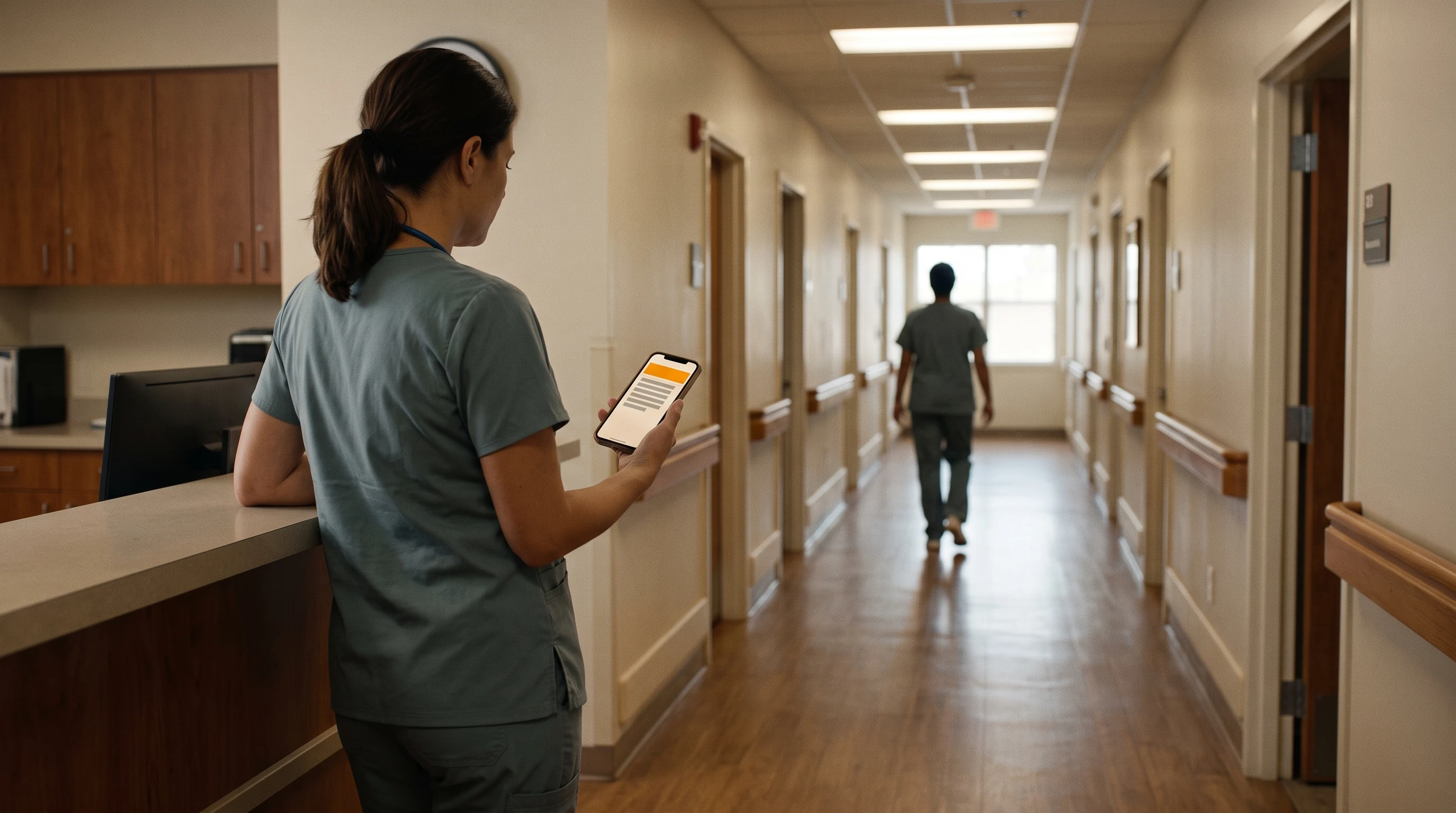
OnShift or Smartlinx on the schedule; a payroll-bureau timeclock or ADP/Paychex on the punches. MicroForensics rides what you already run as a read-only consumer — AM, PM, and NOC shifts keep their structure, and the fifth-hour alert reaches the charge nurse or shift lead while relief can still be sent.
- Clinical
EHR & point of care
PointClickCare and its Point of Care tasking are common on post-acute floors, and med-pass documentation proves the aide was working — not that a duty-free meal happened. MicroForensics never touches the clinical record; it pairs the operational day with the per-pay-period attestation that answers the wage question a clinical chart was never built to answer.
- Home health
EVV & visit verification
CalEVV or a certified alternate EVV system on Medicaid-funded personal care and home health visits. EVV answers a Medicaid billing question — presence at the visit. MicroForensics runs alongside it and adds a per-pay-period wage sign-off: the aide's own, by SMS in English or Spanish, that breaks happened and hours are right.
We build the connector for your stack — by API where one exists, by export, SFTP, or structured manual entry where one doesn’t — scoped and priced in the records diagnostic.
Two overlays reach the same building. SB 525's phased health-care minimum wage began stepping up October 16, 2024; each step lifts the regular rate that meal and rest premiums are priced at, so the cost of a recorded miss rises on a schedule — and coverage turns on your license, which is why the records diagnostic confirms your facility type first. The second is not optional at any license. SB 553 (Labor Code §6401.9) has required a written workplace violence prevention plan, training, and a violent incident log since July 1, 2024, with those records retained five years and produced to employees and their representatives within 15 calendar days of a request. Most operators this size have a plan and an empty log. That is a record California already compels, with a gap where the response should be — and it is the first thing we close.
One production package. Hours, not weeks.
A lawyer’s letter demanding records usually arrives before any lawsuit does, and a §2699 PAGA notice after it. When the letter lands, the authorized custodian of records on your team — not Floburn — exports one production package in hours, not weeks, and authenticates it as the person who has held it all along.
An alert reaches the foreman or dispatcher while the shift is still open, carrying what to do and what to enter — so the break gets taken rather than a premium owed. Entries are captured as the shift happens — timestamped, signature-captured, tamper-evident — not assembled after a claim lands. Payroll, timekeeping, HR, and safety are reconciled into one record, so production is an export from one place rather than a search across several: the payroll records, the timecards with each short break and the premium paid beside it, the written policy your crews acknowledged and each dated per-period sign-off — on a cadence of its own, decoupled from the payroll run — the training completions, and the hazard, heat, and incident records. The records that can go into the package are inventoried with you in the records diagnostic.
The package exists before the letter does — the timeline is a property of how the record is kept, not a promise about your matter. No outcome is guaranteed; every matter turns on its facts.
How production works→What employers in your industry ask us first.
01Our floors are ratio-bound — a caregiver can't walk away for 30 minutes. How can meal compliance even work?
Ratio-bound staffing makes meals hard to schedule; the exposure is that it also makes them hard to prove. Where relief exists, the fifth-hour alert reaches the charge nurse or shift lead in time to send it. Where a break genuinely fails, the recorded exception — premium paid, cause noted — is an answer on the record. What the Donohue presumption punishes is the third case: a normal-looking punch and silence. The per-pay-period attestation removes the silence.
02We already run OnShift and PointClickCare. Don't those document staffing?
They document the schedule and the care. OnShift and Smartlinx show who was on the floor; Point of Care shows tasks and the med pass. Several products in this category can capture a signature, and the box is sometimes configured long before anyone asks who acts on what it surfaces. Capability is not adoption, and a signature is not the loop — what the caregiver affirms about a duty-free 30-minute meal still has to reach someone who pays the premium, changes the relief pattern, and closes the item. §2699(g)(2) names what the reasonable-steps record is built from — periodic payroll audits with action taken in response, lawful written policies, supervisor training on Labor Code and wage order compliance, and corrective action as to supervisors. The attestation is what surfaces the item those four then have to close. MicroForensics sits alongside your systems, not in place of them.
03Our home health aides already clock visits through EVV. Isn't that the record?
EVV answers a Medicaid billing question — was the aide at the visit — under the 21st Century Cures Act mandate. It is built for that question and not for a wage-and-hour one, and on a solo visit the telemetry alone can read as proof the aide worked straight through. MicroForensics routes a short bilingual attestation to the aide's own phone each pay period; that signature pairs the visit telemetry with a wage record, which is a separate document answering a separate question.
04We're an RCFE, not a skilled nursing facility. Does any of this apply to us?
Yes. The meal-and-rest framework and amended §2699 apply to your hourly W-2 staff regardless of license type — the Donohue presumption doesn't check whether CDSS or CDPH issued your license. What changes by license is the overlay: SB 525 coverage turns on facility type, and staffing and documentation duties differ between assisted living and skilled nursing. The diagnostic maps which overlays reach your building; the attestation record is the same either way.
Free 30-minute discovery call.
Tell us about your timekeeping and payroll stack, your headcount, and what’s prompting the conversation. We’ll tell you whether the records diagnostic makes sense, which way to run it — standard, or through your lawyer — and what to expect if you proceed.
Free · 30 minutes · a fit conversation, not a sales call. If the diagnostic isn’t worth doing, we’ll tell you.
Floburn Inc. is not a law firm and does not provide legal advice. Counsel advises Floburn on system design and does not represent your company; retain your own counsel for advice specific to your situation.