The board is documented room by room. The meal period isn’t.
MicroForensics, built for independent and franchise hotel operators running genuine 24/7 properties — housekeeping, banquets, front desk, maintenance — where checkout and room-turn windows collide with the §512 fifth hour and auto-deducted meal punches go quiet. California already requires that time record and the wage statement built on it. What it also requires is the fix entered beside the issue it corrects: the fifth-hour alert in time to clear the board, the premium — where one is genuinely owed — paid and logged, the item closed. A housekeeping supervisor is alerted to a short break and gets it taken while the shift is still open — and when a lawyer's letter demanding records arrives, your own authorized custodian of records answers it from one place, the training and hazard file with it. It runs on the payroll and time clocks your property already has; crews sign off in English or Spanish, every pay period.
Free · 30 minutes · a fit conversation, not a sales call. If the diagnostic isn’t worth doing, we’ll tell you.
This page shows how it works in your industry. For the full walkthrough — the statute text, how we close a missed break, what the record actually contains — see MicroForensics.
Three structural reasons hotel records fail when a PAGA notice tests them.
- 01
Auto-deducted breaks meet the Donohue presumption.
Genuine 24/7 operations put checkout and room-turn windows on a collision course with the §512 fifth hour. A room attendant works through her board's due-outs; the system deducts the 30 minutes anyway, or rounds the punch. Under Donohue v. AMN Services (Cal. 2021), a record that can't show the break happened runs the presumption against the hotel, not the housekeeper.
- 02
Ferra prices premiums at the regular rate.
Ferra v. Loews Hollywood Hotel (Cal. 2021) — itself a hotel case — prices meal and rest premiums at the regular rate, not base hourly, and every step up in the wage floor mechanically raises what a missed or unprovable break costs. No projection in that — arithmetic on a published calendar. The premium math for this industry was set by a hotel's own caselaw.
- 03
The departments with the exposure are Spanish-primary.
Housekeeping runs 52% Hispanic nationally (BLS 2023) and heavily Spanish-primary in California's urban markets — and housekeeping and banquets are the departments generating most break exposure. An English-only handbook acknowledgment from a Spanish-primary crew is a weak exhibit. The per-pay-period attestation runs in English or Spanish, so the departments carrying the exposure are the ones building the record.
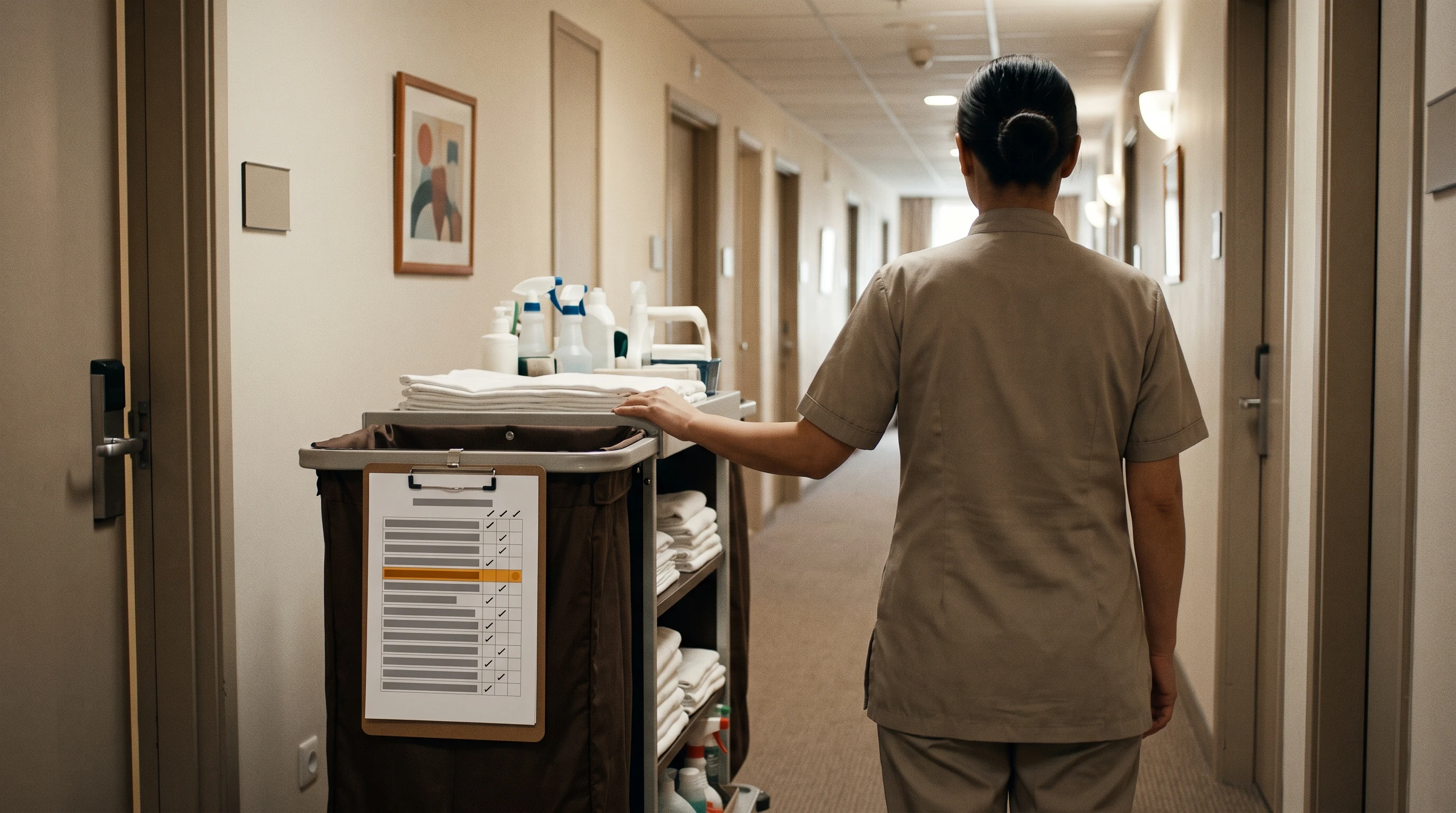
What we build on, and what we add.
- Payroll & time
ADP/UKG-class systems
Hotel payroll and time clocks — ADP and UKG-class platforms, frequently configured with auto-deduct or rounding — plus labor tools like Hotel Effectiveness. Hotel stacks need connector work, so we make no off-the-shelf compatibility claims, and your systems stay exactly where they are.
- The house
Boards, banquets, and the night audit
Housekeeping boards assign room credits across checkouts and stayovers; the banquet calendar drives F&B staffing; the night audit closes the day. MicroForensics reads the shift as actually worked — not as scheduled — and keys the real-time fifth-hour alert to it, department by department.
- The record
Per-pay-period sign-off, EN/ES
Every pay period, room attendants, banquet crews, and desk agents sign — in English or Spanish — that breaks were taken and hours are right, on a timestamped record. No new PMS, no replacement time clock, no app your housekeepers have to learn.
We build the connector for your stack — by API where one exists, by export, SFTP, or structured manual entry where one doesn’t — scoped and priced in the records diagnostic.
Covered Los Angeles hotels — 60 rooms and up — carry an overlay that's already on the calendar: the citywide hotel-worker wage schedule, $25.00 an hour today, reaching $30.00 by January 1, 2030 (ordinance amendment effective June 29, 2026). Under Ferra, each step re-prices a missed or unprovable break at the regular rate. We scope the ordinance in the records diagnostic — and never assume it covers a property it doesn't.
One production package. Hours, not weeks.
A lawyer’s letter demanding records usually arrives before any lawsuit does, and a §2699 PAGA notice after it. When the letter lands, the authorized custodian of records on your team — not Floburn — exports one production package in hours, not weeks, and authenticates it as the person who has held it all along.
An alert reaches the foreman or dispatcher while the shift is still open, carrying what to do and what to enter — so the break gets taken rather than a premium owed. Entries are captured as the shift happens — timestamped, signature-captured, tamper-evident — not assembled after a claim lands. Payroll, timekeeping, HR, and safety are reconciled into one record, so production is an export from one place rather than a search across several: the payroll records, the timecards with each short break and the premium paid beside it, the written policy your crews acknowledged and each dated per-period sign-off — on a cadence of its own, decoupled from the payroll run — the training completions, and the hazard, heat, and incident records. The records that can go into the package are inventoried with you in the records diagnostic.
The package exists before the letter does — the timeline is a property of how the record is kept, not a promise about your matter. No outcome is guaranteed; every matter turns on its facts.
How production works→What employers in your industry ask us first.
01Our timekeeping auto-deducts the 30-minute meal break. Doesn't that cover us?
It's the opposite: the auto-deduct is where the record goes quiet. When a room attendant works through a break in the checkout window and the system deducts the 30 minutes anyway — or rounds the punch — the time record can't show the break happened. Under Donohue v. AMN Services (Cal. 2021), that record runs the presumption against the hotel. What answers a presumption is evidence about the period itself: the attendant's own account of the shift, the §226.7 premium where one was owed, and a dated note of what changed on the board. Labor Code §2699(g) caps PAGA civil penalties at 15 percent where the employer took all reasonable steps before a notice arrives, §2699(h) at 30 percent for remediation within 60 days after — and the existence of a violation, despite the steps taken, is not by itself enough to show the employer failed to take them. The court decides whether the steps were enough.
02We're a franchise property run day-to-day by a management company. Does MicroForensics fit us?
It depends on who the W-2 employer is, and that's the first thing we work out with you on the discovery call. If your entity employs the staff — owner-operator or franchisee — that's the employer we build for. If a third-party management company is the employer of record, that's chain employment in effect and outside what we build for; we'll tell you in the first call rather than sell you a diagnostic that can't fit.
03Half our housekeeping department is Spanish-primary. Do they need a new app?
No new app, and no English-only paperwork. The sign-off runs through SMS or a short link each pay period, in English or Spanish — the room attendant keeps the board, the cart, and the workflow she already has. Bilingual is the default in the hotel deployment, not an add-on: the record is only as strong as the crew's ability to read what they signed.
04We run ADP (or UKG) with Hotel Effectiveness for labor. Do you integrate off the shelf?
We deliberately make no off-the-shelf compatibility claims for hotel stacks. ADP and UKG-class systems in a hotel configuration — auto-deduct rules, rounding, department splits — need connector work, and that work is scoped and priced into the records diagnostic, not discovered mid-engagement. Your payroll, time clocks, and labor tools stay; MicroForensics reads from them and adds the attestation layer on top.
Free 30-minute discovery call.
Tell us about your timekeeping and payroll stack, your headcount, and what’s prompting the conversation. We’ll tell you whether the records diagnostic makes sense, which way to run it — standard, or through your lawyer — and what to expect if you proceed.
Free · 30 minutes · a fit conversation, not a sales call. If the diagnostic isn’t worth doing, we’ll tell you.
Floburn Inc. is not a law firm and does not provide legal advice. Counsel advises Floburn on system design and does not represent your company; retain your own counsel for advice specific to your situation.