A duty-free break takes a floater, not a policy.
MicroForensics, built for California childcare operators — the multi-site centers where Title 22 ratios decide when a teacher can step out of the room. California already requires the time record behind every one of those shifts. What it also requires is the fix entered beside the issue it corrects: the fifth-hour alert in time to send the floater, the premium — where one is genuinely owed — paid and logged, the item closed. A director is alerted to a short break and gets it taken while the shift is still open — and when a lawyer's letter demanding records arrives, your own authorized custodian of records answers it from one place, the training and hazard file with it. Runs on top of the Procare or Brightwheel time data you already produce and the payroll you already run; each pay period, teachers sign off — English or Spanish — that breaks were covered and hours are right.
Free · 30 minutes · a fit conversation, not a sales call. If the diagnostic isn’t worth doing, we’ll tell you.
This page shows how it works in your industry. For the full walkthrough — the statute text, how we close a missed break, what the record actually contains — see MicroForensics.
Three structural reasons childcare-center records fail when a PAGA notice tests them.
- 01
The ratio bind is structural.
Title 22 sets the ratios — one teacher per four infants (§101416.5), one per twelve preschoolers (§101216.3). A teacher inside ratio can't take a duty-free 30-minute meal unless a floater covers the room, so breaks run late, short, or not at all — and the time record shows it. The exposure isn't a policy failure; it's built into the staffing math.
- 02
Donohue presumes the violation.
In Donohue v. AMN Services, the California Supreme Court held that time records showing a missed, short, or late meal period are presumed violations — the employer has to explain. A center's records can be accurate and still silent on whether breaks were covered. The explanation has to be built at the time: the teacher's own account, the premium paid where one was owed, and a dated note of the coverage that changed as a result.
- 03
Filings are rising; the cap is conditional.
The Education & Childcare filing category is up 27.1% year over year — one of only three categories still rising in the Ankura analysis of LWDA notice data through mid-2026. Labor Code §2699(g) caps PAGA civil penalties at 15 percent where the employer took all reasonable steps before a notice arrives and can show it; §2699(h) caps them at 30 percent for remediation within 60 days after. Signed, dated proof, not a handbook — and the court decides whether the steps were enough.
What we build on, and what we add.
- Center management
Procare & Brightwheel
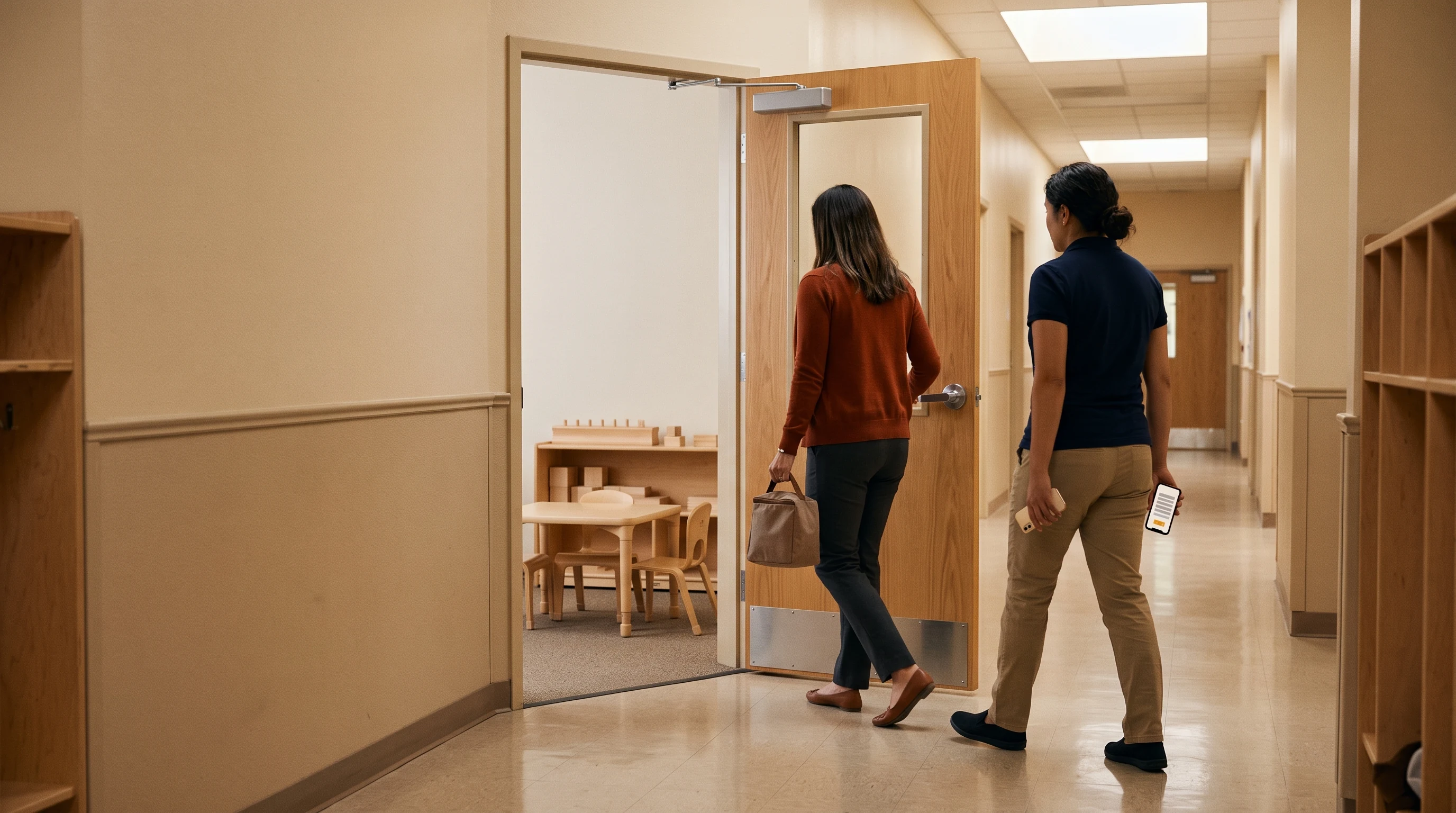
The app that runs check-in, billing, and parent messaging is where your staff clock in and out, too. MicroForensics integrates as a read-only consumer of that time data — teachers, aides, and floaters keep the app they already touch, and nothing changes at the classroom door.
- Payroll
The payroll run
Gusto (where Brightwheel's payroll module hands its hours), QuickBooks Payroll, ADP, or Procare's built-in payroll. MicroForensics reconciles each period's wage statements against the attestation record; the sign-off runs on its own per-pay-period cadence, decoupled from the pay run — we don't replace the payroll run, and nothing about the sign-off is a condition of being paid.
- The attestation layer
Per-pay-period sign-off, EN/ES
Every pay period, teachers, aides, and floaters sign off — English or Spanish — that breaks were covered and hours are right. In a workforce where nearly half the educators are not English-primary at home, Spanish-language attestation approaches a validity requirement; a sign-off your staff can't read is a weak record.
We build the connector for your stack — by API where one exists, by export, SFTP, or structured manual entry where one doesn’t — scoped and priced in the records diagnostic.
Naptime is the overlay native to this industry. Title 22 lets the ratio relax to one teacher per 24 napping children (§101230(c)) — but the remaining teachers must stay immediately available at the center, and immediately available is not the same standard as duty-free. A meal period logged during naptime still needs documented floater coverage, or it lands in the record as an exception.
One production package. Hours, not weeks.
A lawyer’s letter demanding records usually arrives before any lawsuit does, and a §2699 PAGA notice after it. When the letter lands, the authorized custodian of records on your team — not Floburn — exports one production package in hours, not weeks, and authenticates it as the person who has held it all along.
An alert reaches the foreman or dispatcher while the shift is still open, carrying what to do and what to enter — so the break gets taken rather than a premium owed. Entries are captured as the shift happens — timestamped, signature-captured, tamper-evident — not assembled after a claim lands. Payroll, timekeeping, HR, and safety are reconciled into one record, so production is an export from one place rather than a search across several: the payroll records, the timecards with each short break and the premium paid beside it, the written policy your crews acknowledged and each dated per-period sign-off — on a cadence of its own, decoupled from the payroll run — the training completions, and the hazard, heat, and incident records. The records that can go into the package are inventoried with you in the records diagnostic.
The package exists before the letter does — the timeline is a property of how the record is kept, not a promise about your matter. No outcome is guaranteed; every matter turns on its facts.
How production works→What employers in your industry ask us first.
01Our teachers can't leave the room. How does a duty-free break even happen at ratio?
Operationally: a floater covers the room, and the record shows it. The real-time fifth-hour alert reaches the director or front office before the §512 window expires — while there's still time to send coverage. MicroForensics doesn't invent staff you don't have; it documents the breaks that were covered, flags the ones that weren't, and turns the floater rotation you already run into evidence instead of folklore.
02We're on Brightwheel (or Procare). Doesn't it already track staff hours?
It records them — clock-ins, clock-outs, timesheets synced to payroll — and that time data is what MicroForensics reads from. What we add on top is the per-pay-period California break attestation, because a center's records can be accurate and still silent on whether breaks were covered — and under Donohue, a record showing a missed, short, or late meal is presumed a violation unless the employer can explain it. MicroForensics sits on top of the time data and adds the per-pay-period sign-off, the premium when one is owed, and the dated note of what changed in the floater rotation. The explanation, in other words, gets written while it is still true.
03Half our staff is Spanish-primary. Does the sign-off work in Spanish?
Yes — every attestation runs in English or Spanish, by the employee's choice. That matters more in childcare than almost anywhere: Latina educators are 47% of California's ECE workforce, and nearly half of the workforce is not English-primary at home (CSCCE 2024; UC Berkeley 2025 ECE Workforce Study). A sign-off an employee couldn't read is a weak record; one signed in the language she actually uses is the record you want produced.
04We run four sites and no single center has 50 people. Are we too small?
Count the operator, not the site. MicroForensics is built for small and mid-sized California employers, measured by the hourly W-2 roster across the whole company — and in childcare that's usually a multi-site operator, because single centers rarely get there. One attestation record spans every site; each director keeps her own workflow. The diagnostic will tell you plainly whether your headcount and the state of your records make the engagement worth doing.
Free 30-minute discovery call.
Tell us about your timekeeping and payroll stack, your headcount, and what’s prompting the conversation. We’ll tell you whether the records diagnostic makes sense, which way to run it — standard, or through your lawyer — and what to expect if you proceed.
Free · 30 minutes · a fit conversation, not a sales call. If the diagnostic isn’t worth doing, we’ll tell you.
Floburn Inc. is not a law firm and does not provide legal advice. Counsel advises Floburn on system design and does not represent your company; retain your own counsel for advice specific to your situation.